
PHASE 0: NEEDS ASSESSMENT (Pre-Project Initiation)
Get The Worksheets
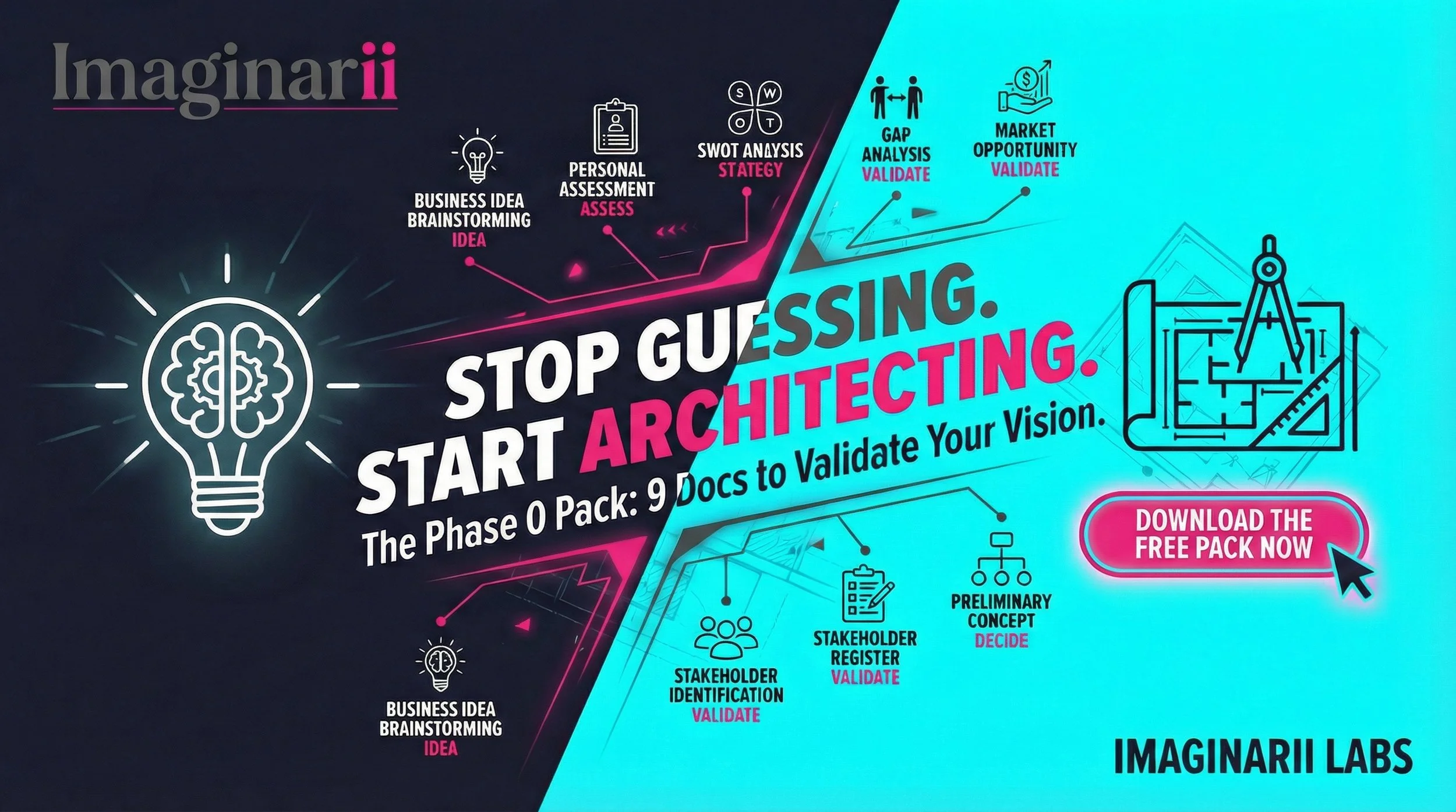
Phase 0: The Startup Architect’s Foundation Pack | 9 Essential Strategy Worksheets
Sale Price:
$0.00
Original Price:
$4.99
Stop the "wantrepreneur" cycle. Most businesses fail not because of bad ideas, but because of a lack of foundation. Before you buy a domain, before you file an LLC, and before you spend a dime on marketing—you need to complete Phase 0.
The Imaginarii Labs Phase 0 Pack is a curated collection of 9 professional-grade strategic documents designed to take you from a chaotic brainstorm to a validated business concept. These are the same frameworks used by high-level consultants to stress-test multi-million dollar ideas.
What’s Inside the Pack:
01 Business Idea Brainstorming Worksheet: Move from "vague idea" to "clear value proposition."
02 Personal Assessment Questionnaire: Ensure your business aligns with your actual life goals and strengths.
03 SWOT Analysis Template: A strategic deep-dive into your Strengths, Weaknesses, Opportunities, and Threats.
04 Gap Analysis Worksheet: Identify exactly what you have vs. what you need to launch.
05 Market Opportunity Assessment Form: Determine if there is actually a "right problem" worth solving.
06 Stakeholder Identification Worksheet: Map out who matters—from customers to partners.
07 Stakeholder Register Template: Keep your network and influence organized.
08 Preliminary Business Concept Statement: Your high-level overview condensed into a single, powerful page.
09 Decision Tree: Should I Start This Business? The ultimate "Go/No-Go" logic gate.
Format: Instant Download (.docx & .pdf versions) Price: $0.00
[ SELF-ASSESSMENT ]
Phase 0 // Module 4
Market & Stakeholders // Knowledge Check
PROGRESS
0%
QUESTION 01 // APPLICATION
A founder is building a dog grooming service in a metro area of 2.4 million people. After filtering by geography and income, their reachable pool is 219,000 households. They estimate capturing 1–3% of that pool in Year 1. Which TAM/SAM/SOM tier does the 1–3% Year 1 estimate represent?
[ FRAMEWORK NOTE ]
QUESTION 02 // ANALYSIS
A founder is validating market need for a B2B invoicing tool. Which of the following constitutes actual evidence of market demand rather than an assumption?
[ FRAMEWORK NOTE ]
QUESTION 03 // EVALUATION
A founder calculates a TAM of 2 million potential customers and a SAM of 400,000 reachable customers. Their SOM projection shows 800 customers in Year 1 at $500 annual revenue each — generating $400,000. Their annual operating costs are $380,000. How should this be evaluated at Gate 0?
[ FRAMEWORK NOTE ]
QUESTION 04 // APPLICATION
A city licensing department has the authority to deny or revoke the founder's operating permit but has no personal interest in the business's success. Using the Power/Interest matrix, what engagement strategy does the framework prescribe?
[ FRAMEWORK NOTE ]
QUESTION 05 // APPLICATION
A founder completes their Stakeholder Identification worksheet but only lists customers, suppliers, and potential investors. According to the framework, which critical stakeholder category has been omitted?
[ FRAMEWORK NOTE ]
QUESTION 06 // ANALYSIS
A founder researches their target market and finds no direct competitors offering the same solution. How should this finding be interpreted according to the Module 4 framework?
[ FRAMEWORK NOTE ]
QUESTION 07 // SYNTHESIS
A founder's Stakeholder Register reveals a conflict: their primary supplier has high influence over delivery timelines, but a key customer segment requires faster turnaround than the supplier can currently provide. What does the framework prescribe?
[ FRAMEWORK NOTE ]