
You Don't Need a Genius Idea — You Need a Good Problem to Solve
Business Entrepreneurship Education
Written By Brian McGauley
This is the first post in a series on starting a business from scratch. It pairs with the Business Startup Roadmap Course [stay tuned - under construction] and the free Phase 0 worksheets available in our Starter Kit.
There's a particular kind of paralysis that hits people who want to start a business. You sit there with a notebook or a blank screen, waiting for the brilliant idea to arrive. The one that's going to change everything. The one nobody's thought of yet.
And you wait.
And nothing comes. Or worse, something comes, and you immediately talk yourself out of it because someone else is already doing it, or it doesn't feel big enough, or you read somewhere that the market is too saturated.
Here's the thing nobody tells you early enough: the idea is the least important part. Most successful businesses didn't start with a flash of inspiration. They started because somebody got annoyed enough by a problem to actually fix it. And then they realized other people had the same problem and would pay to have it fixed, too.
That's the whole secret. That's it.
Why "Find Your Passion" Is Bad Advice
You've heard this before. Follow your passion. Do what you love and the money will follow. It sounds right. It feels motivating. And for a small percentage of people, it works out.
For most people, it's a trap.
The problem with passion-first thinking is that passion doesn't care about markets. You might be deeply passionate about hand-painting miniature birdhouses, and that's wonderful, but passion alone won't tell you whether anyone will pay $45 for one, or whether your materials cost makes that price unsustainable, or whether your target customer even knows where to find you.
Passion is fuel. It keeps you going when things get hard. But it's not a business model.
What actually works, over and over again, is problem-first thinking. Instead of asking "What do I love?" you ask "What's broken?" Instead of looking inward at your interests, you look outward at the world around you and start paying attention to friction. Where do people get stuck? What takes too long? What costs too much? What's ugly, confusing, or just plain frustrating?
Those questions lead to real businesses. Not always exciting ones. Not always sexy ones. But real ones.
The Best Ideas Are Already in Your Daily Life
There's a reason so many successful founders built their first product to solve their own problem. They weren't trying to be visionary. They were annoyed.
Sara Blakely cut the feet off her pantyhose because she couldn't find what she wanted in stores. That became Spanx. Stewart Butterfield built Slack because his game development team needed a better way to communicate internally. The game failed. The communication tool became a $27 billion company. James Dyson spent five years and over 5,000 prototypes because he was frustrated with how badly his vacuum cleaner worked.
None of these started with "I want to start a billion-dollar company." They started with "This doesn't work, and it should."
You already know things that don't work. You deal with them every day. The difference between someone who complains about a problem and someone who starts a business is that the second person stops and asks: could I fix this? And would anyone else pay me to?
That second question matters. Your own frustration is the starting point, not the finish line. But it's a remarkably good starting point, because if a problem bothers you enough to notice it, there are probably thousands of other people in your same industry, your same role, or your same situation who feel the same way.
Your Expertise Is the Unfair Advantage
There's a concept in business strategy called domain expertise, and it's worth understanding even if you've never taken a business class.
When you work in a field for any length of time, you accumulate knowledge that outsiders don't have. You learn the unwritten rules. You see the inefficiencies that everyone just accepts because "that's how it's always been done." You know which tools are garbage, which processes waste time, and which problems cost real money even though nobody's tracking them.
That knowledge is worth something. It's actually worth a lot.
If you're a teacher who's spent eight years building lesson plans, you know exactly which parts of curriculum planning eat up time unnecessarily. If you're an electrician, you know which parts of job estimation are still done on the back of napkins when they could be automated. If you run a food truck, you know that inventory tracking for mobile vendors is a nightmare that most software companies haven't bothered to solve because the market looks too small from the outside.
The person best positioned to solve a problem in any industry is usually someone already working in that industry. Not a Silicon Valley engineer looking at it from a thousand miles away. You.
This is why brainstorming your business idea shouldn't start with "What's trending?" or "What's the next big thing?" It should start with "What do I already know that other people don't?" and "What problems do I see every day that nobody's fixed yet?"
The Structured Approach to Brainstorming
If you're serious about finding a viable business idea (not just daydreaming about one), you need some structure. Sitting in a coffee shop and hoping for inspiration is not a strategy.
In our Business Startup Roadmap [stay tuned for full course - under construction], we call this Phase 0: Needs Assessment. It happens before you write a business plan, before you file paperwork, before you spend a dime. It's the unglamorous, overlooked work of figuring out whether your idea is worth pursuing at all.
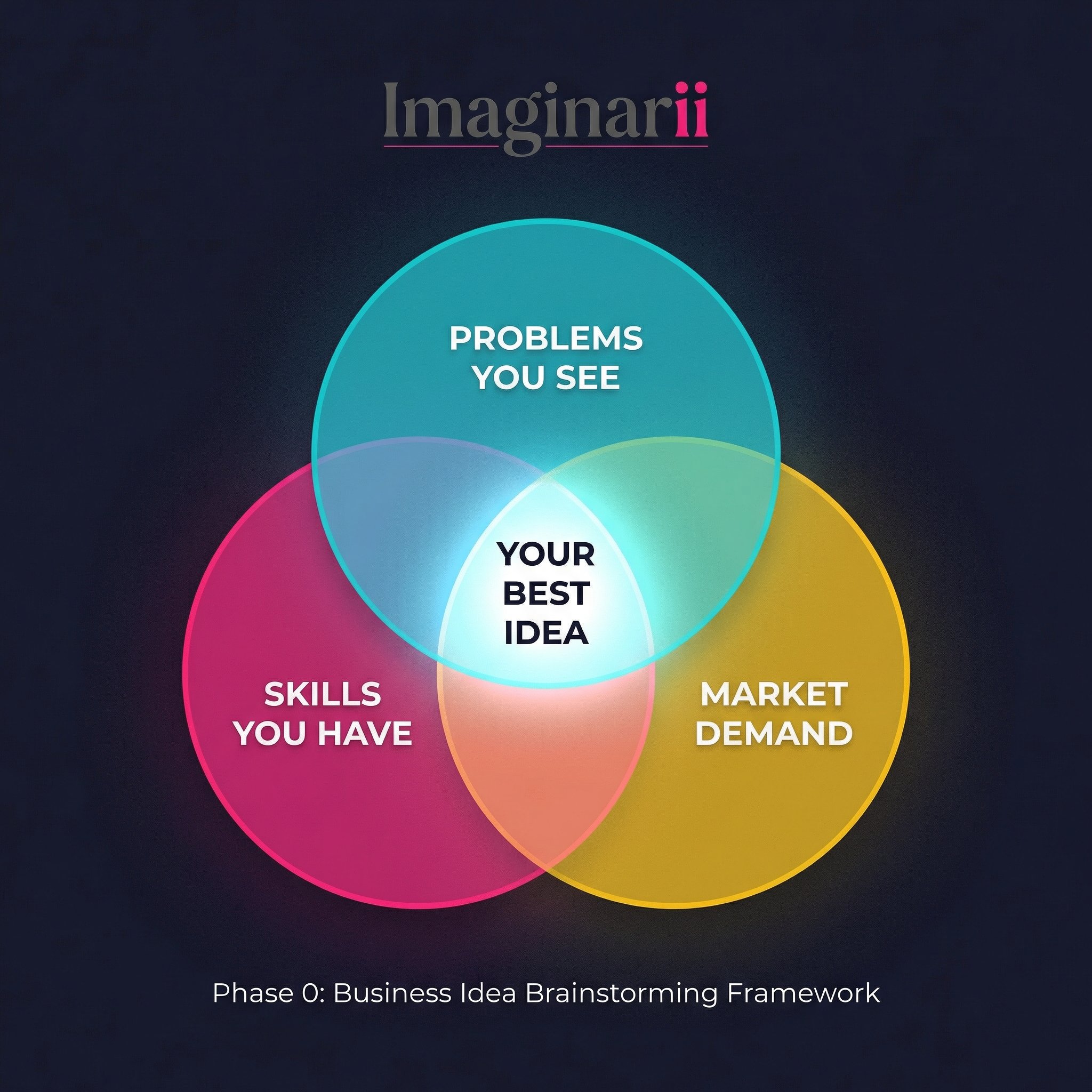
The brainstorming piece of that starts with four questions:
What problems frustrate you? Not business ideas. Problems. Things that are broken, slow, expensive, confusing, or just badly designed. Write them all down without filtering. If your HOA's communication system drives you crazy, write it down. If scheduling appointments at your kid's school feels like it was designed in 1997, write that down too.
What are you actually good at? Skills, experience, knowledge. Not just what you enjoy, but what you're competent enough at that someone would trust you to deliver. Be honest here. If you've never coded in your life, "build an app" probably isn't your first move. But if you've spent ten years managing logistics, you know things about supply chain friction that are genuinely valuable & exploitable.
What's happening in the market? Trends you've noticed. Businesses that seem to be thriving. Gaps you've spotted where demand exists but supply doesn't. This isn't about reading TechCrunch and chasing whatever's popular. It's about observing the world around you and asking what it tells you.
Where do those three things overlap? A problem that frustrates you, that you have the skills to address, and that the market seems to want solved. That overlap is where your best ideas live.
The Business Idea Brainstorming Worksheet walks you through this step by step. It's designed so you can sit down with it for 30 to 60 minutes and come out the other side with two or three ideas worth testing further, instead of a vague feeling that you should "do something."
What Comes After the Idea
Finding a problem to solve is step one. It's an important step, but it's just the beginning.
After brainstorming, you still need to figure out whether you're personally ready for this (that's the Personal Assessment in Doc #2). You need to take an honest look at your strengths and weaknesses. You need to check whether the market is real and not just a feeling you have. You need to identify who's going to be affected by this business, from your family to your future customers.
All of that is Phase 0 work. We'll cover each piece in this series over the coming weeks.
But it all starts here. Not with a genius idea. Not with a business plan. Not with a logo or a website or an LLC filing. It starts with paying attention to the problems that are already sitting right in front of you. The ones you've been stepping over every day without realizing they might be worth picking up.
Get Started
The Business Idea Brainstorming Worksheet is the first of nine Phase 0 worksheets in our Business Startup Starter Kit. It's free to download and designed to get you from "I should start something" to "Here are two or three real ideas worth exploring" in about an hour.
If you want the full guided experience, the Business Startup Roadmap Course [stay tuned - under construction] walks through every phase of starting a business, from needs assessment through launch and beyond, using the same project-based framework that actual project managers use. More on that soon.
Next week: Are You Actually Ready to Start a Business? (An Honest Self-Check) — where we stop talking about ideas and start talking about you.
This post is part of the Starting from Scratch series from Imaginarii Labs. Imaginarii is a creative services business run by Brian McGauley out of California. The Business Startup Roadmap course and Phase 0 worksheets are available through the Labs shop as a bundled collection.